


Picture this: It’s 10 p.m., and someone’s lower back has been bothering them all day. Instead of scrolling through pages of Google results, they open ChatGPT and ask:
“Who’s a good chiropractor for back pain near me?”
A few seconds later, they have an answer and a short list of clinics to consider.
Is yours on that list?
That’s where generative engine optimization (GEO) comes in.
As more patients turn to AI tools like ChatGPT, Gemini and Google’s AI Overviews to find answers, healthcare clinics have a new opportunity to be part of that conversation. GEO helps make your clinic easier for AI tools to find, understand and potentially include when patients are looking for care.
Here’s what GEO means for your clinic, how it works alongside traditional SEO, and a few simple ways to get started.

What is generative engine optimization?
Generative engine optimization, or GEO, is really about making sure your clinic is easy to find and understand when patients turn to AI for help.
When someone asks ChatGPT or another AI tool a question about their health or looks for a local healthcare provider, they may get an answer instead of a page full of search results. That answer might mention specific clinics, services or practitioners.
That means your online presence can play a role in whether patients discover your clinic in the first place. If your website clearly explains what you offer, where you’re located and who you help, you’re giving both patients and AI tools the information they need to understand your clinic.
The goal is simple: make it easy for people to find your clinic, understand what you do, and determine whether you’re the right fit for their needs.
How is GEO different from traditional SEO?
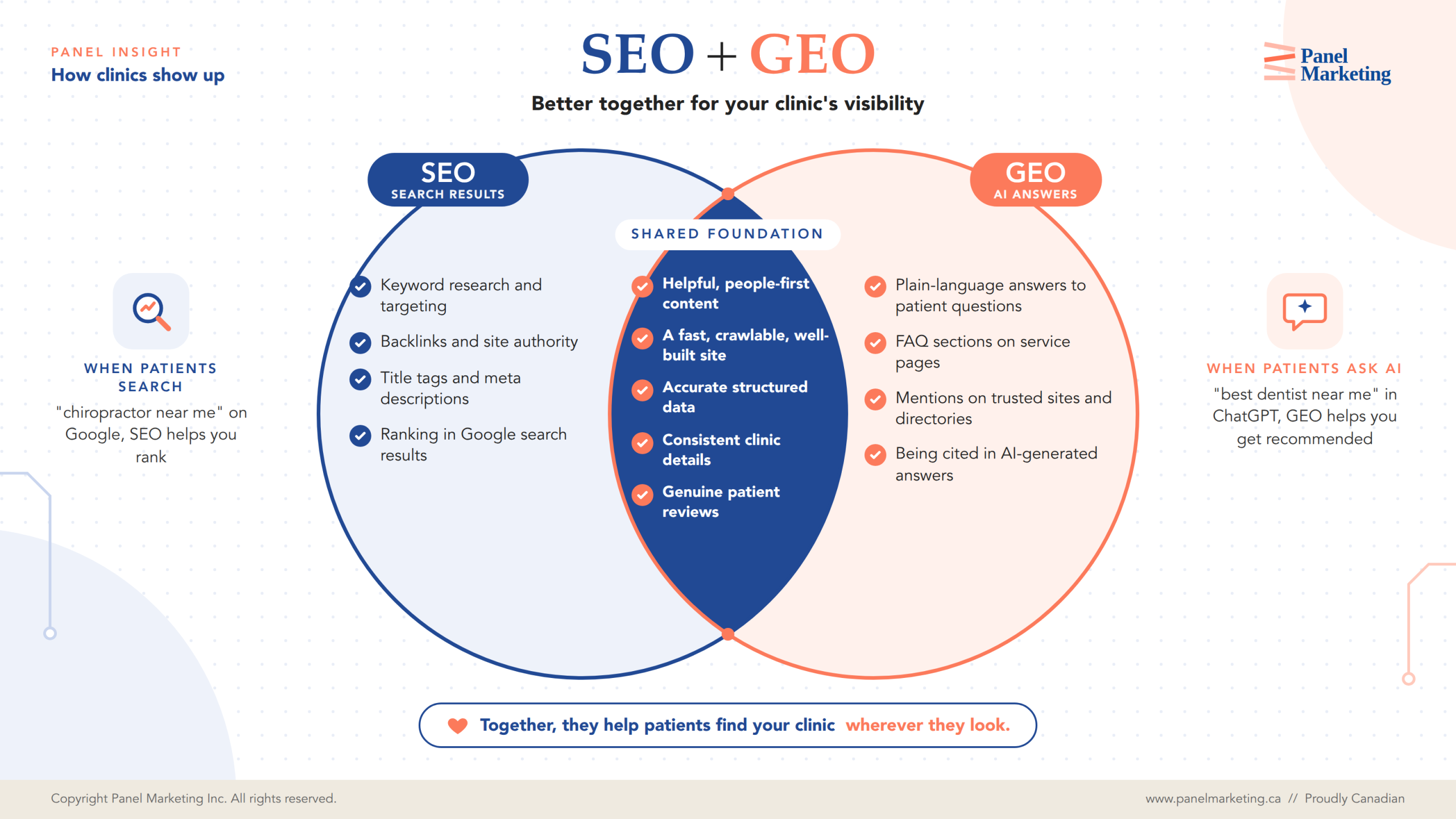
GEO and SEO aren’t competing strategies. They work together.
- Traditional search engine optimization focuses on helping your website appear in search results when someone searches for a relevant service or question.
- GEO takes that a step further by focusing on how your clinic may appear within AI-generated answers.
There’s plenty of overlap between the two. The same fundamentals still matter: helpful, reliable, people-first content on a website that search engines can access and understand. The difference is really in the way people are finding and consuming that information.
Instead of searching:
“Physiotherapist for knee pain Calgary”
a patient might ask:
“Who should I see for ongoing knee pain in Calgary?”
AI tools are designed to understand the question behind the search and provide a useful response. That makes clear, conversational, patient-focused content more important than ever.
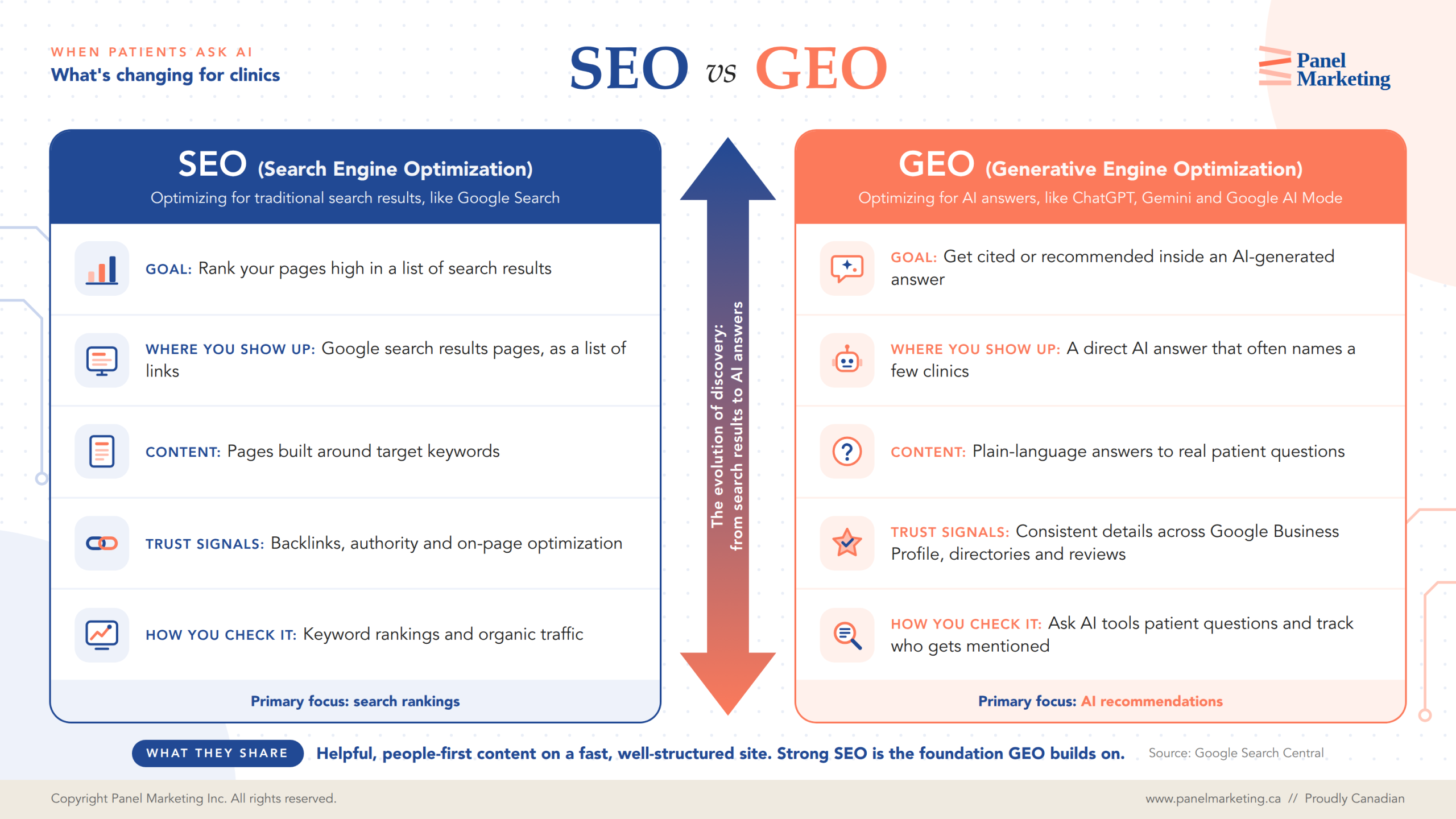
So, how can your clinic show up in AI answers?
You don’t need to completely rebuild your marketing strategy. Start with the basics and make sure your clinic is giving search engines and AI tools plenty of clear, consistent information to work with.
Answer the questions your patients are already asking
Think beyond service names.
Patients want to know things like:
- What causes my knee pain?
- Do I need physiotherapy after an injury?
- What happens during my first chiropractic appointment?
- Can massage therapy help with headaches?
- When should I see a podiatrist?
- How long does it take to recover from a concussion?
Build those questions into your service pages, FAQs and blog content. The goal isn’t to write for a robot. It’s to answer real patient questions in a way that is easy for both people and AI tools to understand.
Be specific about what you do
Make it easy to understand your clinic at a glance.
Clearly explain your:
- Services
- Locations
- Areas of care
- Practitioner specialties and credentials
- Conditions you treat
- Hours and contact information
The more specific and useful your information is, the more context AI tools have when determining whether your clinic is relevant to a patient’s question.
Keep your information consistent
Your clinic shouldn’t have five different versions of itself online.
Make sure your clinic name, address, phone number, hours and services are accurate and consistent across your website, Google Business Profile and relevant online directories. Small discrepancies can create unnecessary confusion for both patients and search technology.
Build trust with genuine patient reviews
Reviews do more than influence someone deciding whether to book an appointment. They can also provide useful context about your clinic, including the services patients use and the experiences they have. Encourage genuine feedback from your patients and make it easy for them to share their experience.
Make your website easy to understand
A helpful website isn’t just about looking good. Your content should be organized clearly, your pages should be easy to navigate, and important information should be easy to find. Technical elements such as structured data can also help search engines better understand your website.
At Panel Marketing, our website development team keeps search visibility in mind when building healthcare websites.
GEO works with SEO, not instead of it
You don’t need to choose between GEO and SEO.
A strong SEO strategy gives your clinic a foundation for being discovered through traditional search, while GEO considers how that same information may be interpreted and surfaced by AI-powered search experiences.
Think of GEO as the next layer of search visibility, not a replacement for the work you’re already doing.
Frequently asked questions about GEO
Does my clinic need GEO if we already do SEO?
SEO gives you a strong starting point because many of the same fundamentals matter to both search engines and AI tools.
GEO simply puts more emphasis on creating clear, useful answers to the questions your patients are actually asking.
In that sense, it can be thought of as an extension of your SEO services, rather than a completely separate strategy.
How can I tell if AI tools are recommending my clinic?
Try asking AI tools the same kinds of questions your patients might ask.
For example:
“Who are the best physiotherapy clinics for sports injuries in Calgary?”
or
“Where can I find a chiropractor for back pain in Calgary?”
Look at which clinics are mentioned and which websites or sources are referenced.
It’s worth checking these searches periodically because AI-generated answers can change as information and search systems evolve.
Can a small clinic compete in AI search?
Being a smaller clinic doesn’t mean you can’t build a strong online presence. Clear service information, useful content, accurate local information and genuine patient reviews all help give AI tools more context about your clinic.
The key is making sure your expertise and the services you offer are easy to find and understand.
How long does it take to show up in AI-generated answers?
There isn’t a guaranteed timeline or a guaranteed position in an AI-generated answer.
Your visibility can depend on factors such as your existing online presence, local competition, content, reviews and how consistently your information is maintained.
A clear marketing plan can help you build these pieces over time and track what’s changing.
The bottom line: make your clinic easy to find and easy to understand
Search is changing. Patients aren’t only typing keywords into Google anymore. They’re asking questions, having conversations and turning to AI for recommendations and information. That doesn’t mean traditional SEO is going away. It means your clinic’s online presence has more ways to be discovered.
The clinics that give patients and the technology helping them search clear, useful and trustworthy information will be better positioned to be part of those conversations.
GEO isn’t a magic trick or a shortcut to the top of search.
It’s about doing something your marketing should already be doing: clearly explaining who you help, what you offer and why patients should be able to find you.
Want to know if your clinic is showing up?
Curious what happens when someone asks AI to recommend a clinic like yours? Let’s connect and see what patients and AI find when they search for your clinic.
Panel Marketing helps Canadian healthcare practices build SEO, content and digital marketing strategies designed to improve visibility across traditional search and emerging AI-powered search.